
I attended the Quirks Event in London in early May. First of all, congratulations to the organisers for running a first-class event at the Intercontinental Hotel near the O2 in Greenwich.
Having recently written a blog article about AI’s challenge to achieve the impossible – faster, cheaper and better, I was curious to hear what the speakers had to say. Indeed, one software supplier concluded his talk by claiming that his company had truly achieved faster, cheaper and better. However, with many speakers being research buyers rather than suppliers, the message was largely about faster, cheaper.
Crunching Data
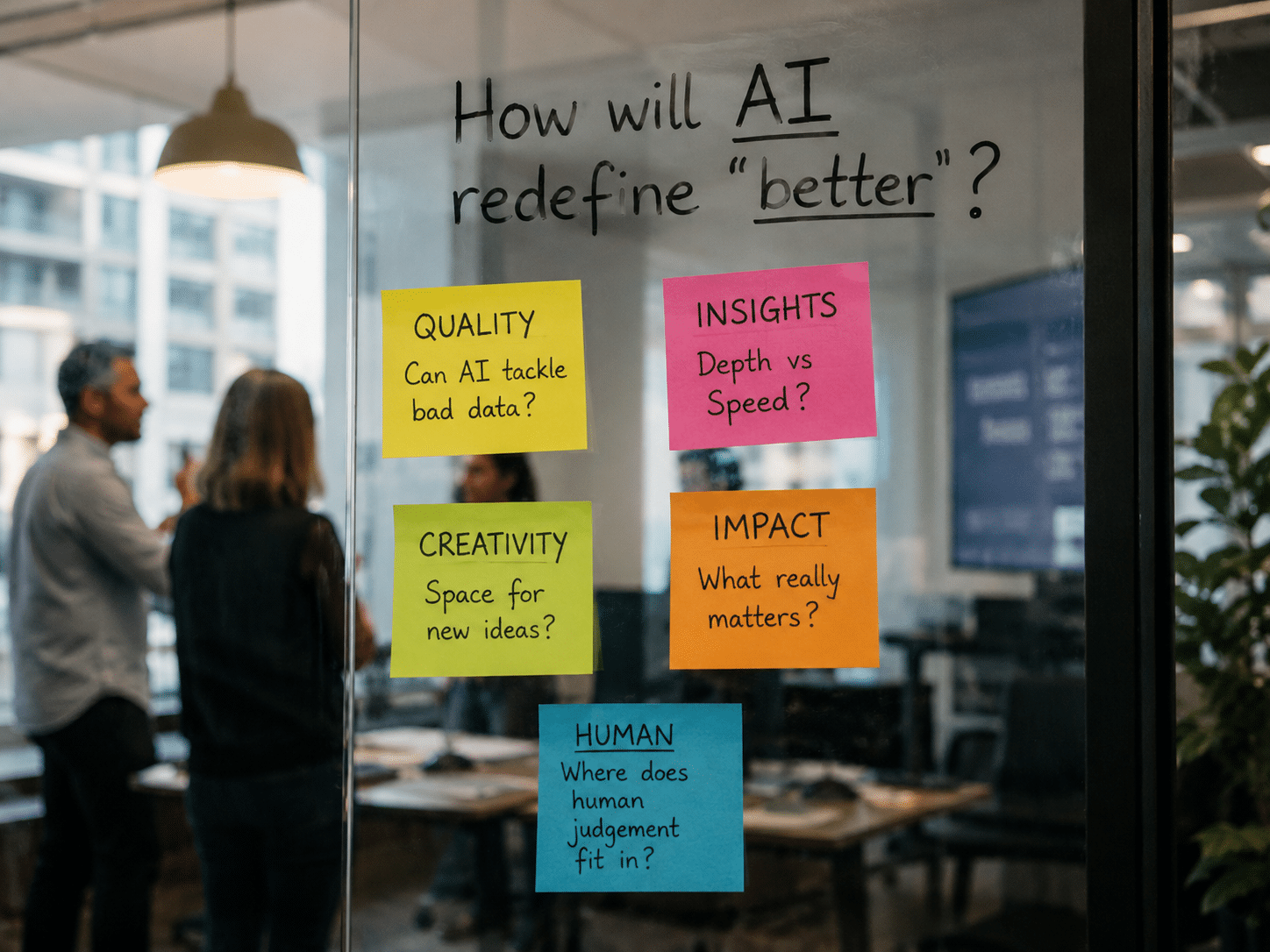
Admittedly, as someone involved for more years than I care to admit in quantitative research, there were tales of how qualitative research data could now be ‘crunched’ to produce output that was meaningful and previously impossible, especially when there are copious amounts of text.
As I alluded to, I am old enough to remember the groundbreaking impact computers had on quantitative research when we moved from four-bar gates and counter-sorters to calculate even the simplest crosstabs or topline counts. And if you don’t know what a counter-sorter is, Google it, although here’s a link to help you on your way.
Computers meant that market research data could be ‘crunched’ with negligibly extra effort if the sample size was 100 or 10,000. And I guess that quantum leap applies to qualitative research data now that it can be ‘crunched’ thanks to AI.
Quicker Insights
Several client-side speakers spoke about the benefits of AI, including the ability to leverage insights and make decisions much more quickly. This sounds like a competitive advantage until you realise, well, everyone is able to make quicker decisions, so the claim of being ‘better’ would perhaps be more accurately ‘keeping up with the Joneses’ – or, to sound more business-like, holding parity.
Cheaper also came up regularly, though I was more switched on by one speaker who focused on viability. Some things are so labour-intensive that one can’t justify the cost or, perhaps, one never quite gets around to it. As the speaker observed, AI made impractical things possible. That’s great news, of course.
Better?
But I was waiting for the word ‘better’ to be the focus of someone’s talk. One or two speakers talked about how AI agents made deliverables easier to customise, and I found this a real advantage. 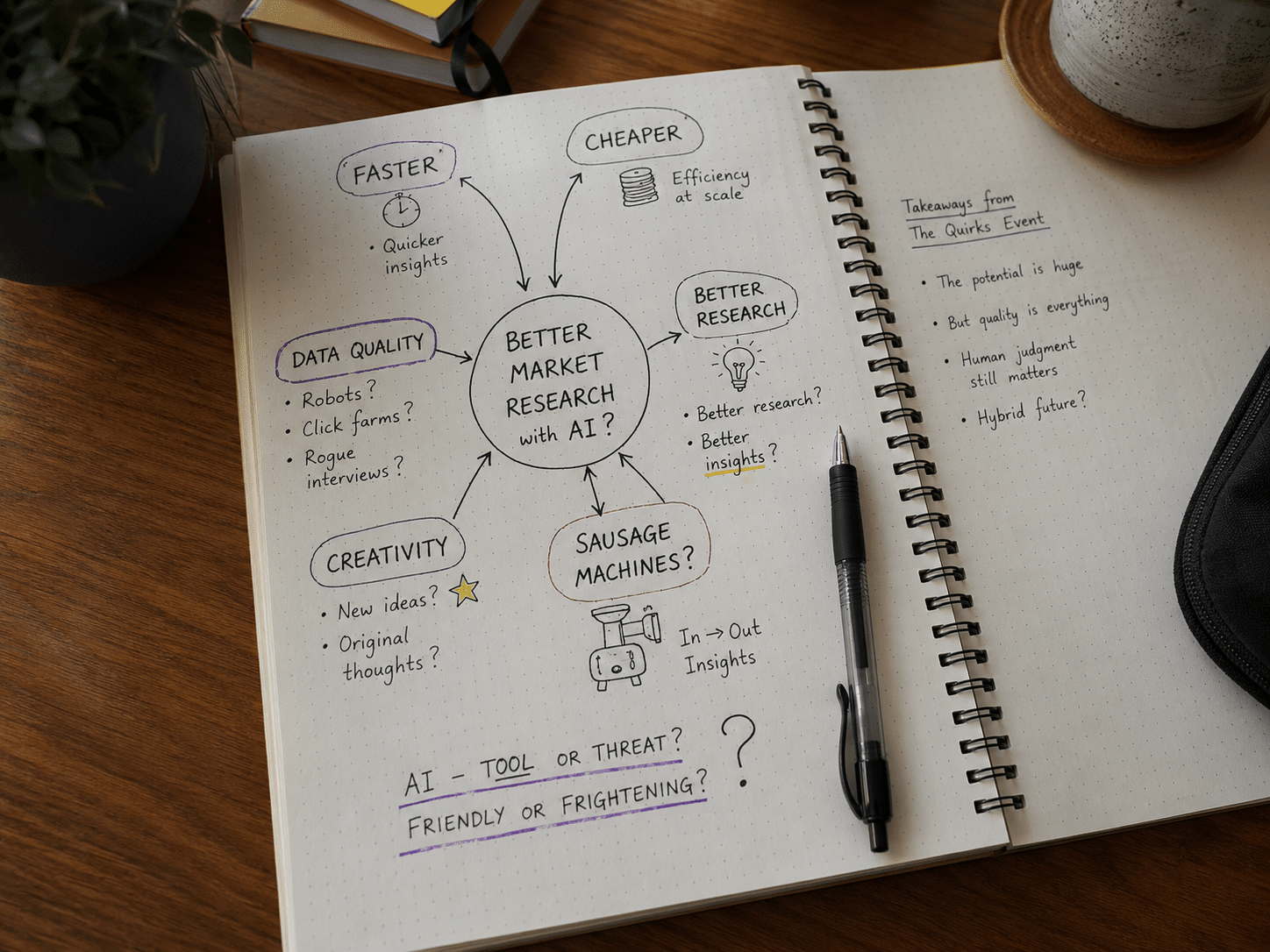 The concept that if you can deliver your research to a client with a couple of bells and whistles that make their life easier, that’s a definite benefit.
In the word cloud forming in my head, faster and cheaper were still the two words that filled most of the space, with many smaller words dotted around them. I was disappointed on three fronts, if I am honest.
Are we only talking about AI?
Firstly, at recent conferences, data quality, the threat of robots/click farms, and quotes about the percentage of rogue interviews are quite frankly alarming. Is this being brushed under the carpet – or, maybe, more like an unwelcome guest at a party? Can AI save the day on this (and every one of the 16 papers I attended focused wholly or significantly on AI)?
Secondly, where is the ‘better’? I didn’t hear a lot about ‘better research’ or ‘better insights’, except in the slightly off-centre references I mentioned previously. Is research going to get better? Has the golden age passed? I don’t know. You tell me.
Thirdly, I didn’t see much creativity, and this is the bit I find saddest. AI can encourage efficiency at the expense of originality, and, judging from the presentations, there was little that felt startling or that you could file under ‘new thoughts’ in research terms. Only two or three years ago, many papers were ‘new thoughts’, new ideas, or things practitioners were trying. Is AI just making us faster and cheaper?
Sausage machines
I’ll add a fourth thing, while I’m at it. I know I am speaking in generalisations, but from my tours around the exhibition stands, too many suppliers appeared to be offering ‘sausage machines’. Feed your data in, and out will come insights. Now, this is, of course, a tongue-in-cheek, somewhat facetious comment, but surely the research industry has to be thoughtful; otherwise, it is dead.
If one line stuck in my head, it came from one of the few speakers who talked more cautiously about AI. I liked the line that using the acronym ‘AI’ made it sound friendly, unthreatening and just another tool. Contrast that with ‘Artificial Intelligence’, which sounds threatening and about to take everyone’s job. A good observation, indeed.
Doing the impossible?
However, there was a genuine buzz at the conference, and I found it as interesting as any conference I have attended over the years. Some of the ways people have used AI to make things that would otherwise be impossible are groundbreaking. Personally, I am a big fan of AI agents, as long as they have a clear purpose and require minimal human interaction. AI agents that ask five stupid questions or make five arbitrary decisions on your behalf do not necessarily improve workflow or quality.
Our response to AI
The event reassured me that our direction with MRDCL is solid. Although we have some non-AI developments in the pipeline (yes, we do think beyond AI), we have already considered adding an AI reporting agent on the back of MRDCL and rejected it. We are now busy building an AI agent to help users define the variables and outputs they need. With an AI agent, asking MRDCL to run every question analysed by age, gender and region for buyers of a brand could be achieved in seconds rather than through laborious coding.
And why have we rejected the idea of an AI reporting agent on the back of MRDCL? I think the market is already too cluttered in this area. There will be some big winners and even more big losers, but, at the end of the day, it’s not our area of expertise. Workflows, automation, efficiency and ‘nothing too difficult’ are our strengths. If you want to connect to another platform to automate a report or your slides, there are plenty of choices, and there will be more, delivered by specialists in the field. We can provide that bridge.
Are we still reinventing ourselves?
After the farewell drinks, I made my way back past the O2 and recalled how the venue had successfully reinvented itself. Is market research reinventing itself? It is. What it will look like in three years is interesting to find out. I just hope innovation, originality and better thinking don’t get lost along the way.
Latest Posts
 There are a million AI experts out there. Can they all be right?September 8, 2026 - 10:51 am
- How many software products SHOULD you use?July 14, 2026 - 11:02 am
- Is Market Research Redefining “Better”?June 2, 2026 - 11:36 am
- Getting Software Development RightMay 5, 2026 - 9:59 am
- Faster, Better, Cheaper. If Only.March 4, 2026 - 10:41 am
- Why Some Platforms Embed Their Analysis Engine (Instead of Building One)December 29, 2025 - 2:39 pm
- Why the Smart Platforms Don’t Try to Do EverythingOctober 3, 2025 - 11:23 am
- Why Modern Market Research Needs a Data Hub (Not Another Platform)August 2, 2025 - 12:42 pm
- From Craft to System: How Analysis Becomes ScalableJune 25, 2025 - 1:24 pm
- Why Tracking Studies Break and How to Stop Them BreakingApril 1, 2025 - 11:43 am
- Real Survey Data Is Messy. Your Software Should Expect That.February 8, 2025 - 1:59 pm
- When Scripting Is the Right Tool and When It Isn’tJanuary 8, 2025 - 11:08 am


